
Last reviewed: October 2026 | Next review: February 2027
Every FX/CFD broker comparing forex liquidity bridge providers eventually runs into the same problem: every provider claims to be the best fit and none of the marketing pages uses the same yardstick. This guide does not attempt to crown a winner. Instead, it sets out a consistent set of public criteria and evaluates cBridge, Centroid Solutions, FXCubic, oneZero, PrimeXM and Tools for Brokers against them so brokers can build their own shortlist rather than inherit someone else's.
The right provider depends on your platform setup, operating model, expected scale, internal resources and commercial priorities. A brokerage running a lean MT5 operation with one liquidity provider has a very different set of requirements from a multi-platform prop firm connecting to a dozen liquidity sources. Nothing below should be read as a ranking.
What should a liquidity bridge provider help a broker manage?
A liquidity bridge for brokers sits between trading platforms and liquidity providers, handling price and order flow between them. At a minimum, a bridge provider should give a broker a reliable way to manage:
Connectivity to trading platforms (MT4, MT5, cTrader or FIX API Takers) and to one or more liquidity providers
Price aggregation, so multiple liquidity provider feeds become a single, tradeable composite quote
Order routing, including how orders are split, prioritised or sent to a backup source if a primary liquidity provider disconnects
Exposure and risk controls, so dealing and risk teams can see and manage what the book looks like in real time
Monitoring, analytics and reporting, covering execution quality, liquidity provider performance and regulatory obligations
Infrastructure that scales with volume without becoming a support burden
If you need a closer look at how this infrastructure works, start with our guide to what a liquidity bridge is and how it supports broker operations.
How we evaluated the providers
Every provider was assessed against the same ten criteria using its own public pages as the primary source. "Not publicly confirmed" means that the reviewed sources did not state the detail; it does not mean the capability is unavailable.
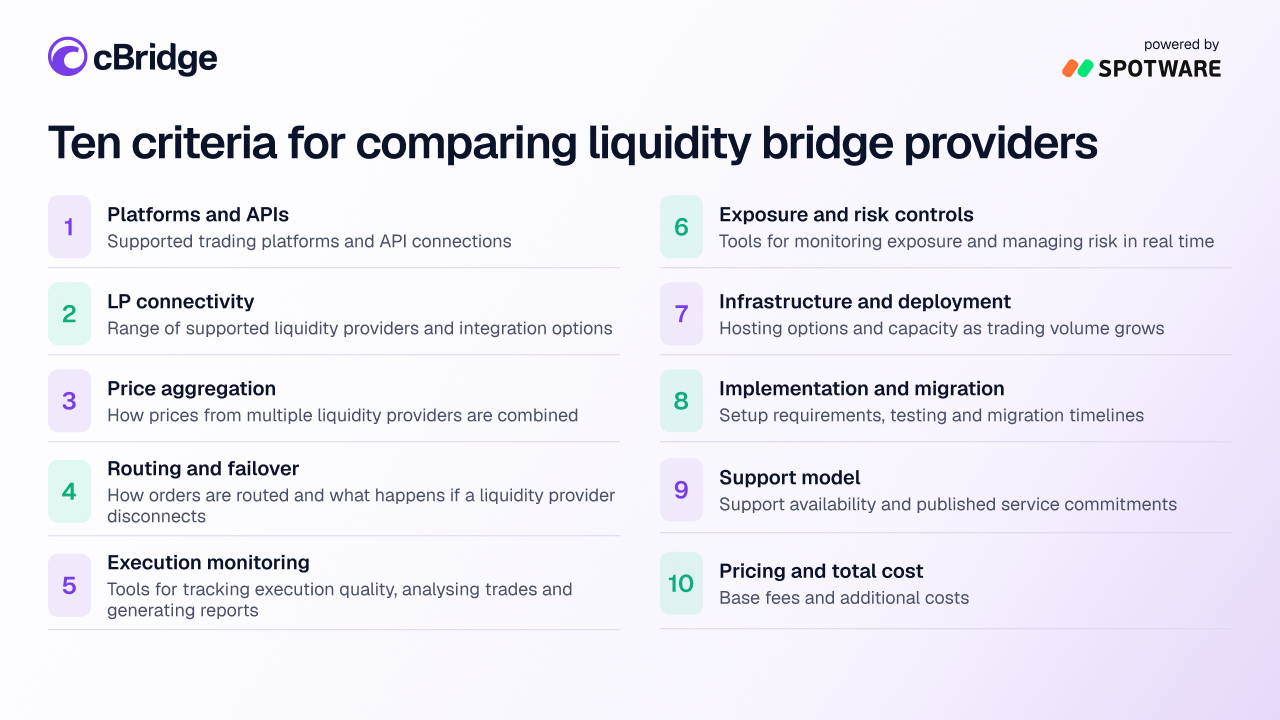
alt description: Ten criteria used to compare liquidity bridge providers: platforms and APIs, liquidity provider connectivity, price aggregation, routing and failover, execution monitoring, exposure and risk controls, infrastructure, implementation, support and total cost.
The ten evaluation criteria
Supported trading platforms and APIs
Liquidity-provider connectivity and integration options
Price aggregation and market-depth controls
Order-routing flexibility, fallback and failover
Execution monitoring, analytics and reporting
Exposure and risk-management capabilities
Infrastructure and deployment model
Implementation, testing and migration requirements
Support model and published service commitments
Pricing structure and total cost of ownership
The comparison is reviewed quarterly because providers regularly update features, integrations and pricing.
Shortlist at a glance
Presented alphabetically, not by ranking:
cBridge: Fixed, infrastructure-based pricing with no volume fees, connecting MT4, MT5, cTrader and FIX API to multiple liquidity providers.
Centroid Solutions (CS 360): Institutional-grade connectivity and execution engine with quant-driven risk and hedging tools, hosted from major financial data centres.
FXCubic: Configurable bridging and aggregation engine with granular, per-account execution profiles and toxic-flow protection.
oneZero: Long-established retail and institutional liquidity technology provider with tiered packages from start-up to enterprise scale.
PrimeXM (XCore): Aggregation and connectivity engine built around ultra-low latency with deep historic monitoring and logging tools.
Tools for Brokers (Trade Processor): Multiplatform bridge with six aggregation modes, documented automatic failover and a built-in business intelligence module.
Individual provider profiles
cBridge
Suitable broker profile: Brokers and prop firms on MT4, MT5, cTrader or FIX API who want cost predictability as volume grows rather than fees that scale with trading activity.
Supported environment: MT4, MT5, cTrader and FIX API Taker, connecting to multiple liquidity providers such as LMAX Group, Swissquote, 26 Degrees Global Markets, iSAM Securities and Finalto, among 50+ integrations and FX providers. Brokers should confirm support for their required liquidity providers during the demo.
Differentiating focus: Fixed, infrastructure-based pricing tied to servers and connections rather than trading volume, alongside an operations-first interface with built-in configuration validation.
For qualified brokers, cBridge also offers Markout Report, which provides continuous account-level markout and pre-trade drift analysis, explainable risk scores and a direct path from investigation to routing action within the same workflow.
Confirm during a demo: Required liquidity provider connections, trading-server connections, expected capacity, implementation scope and the applicable pricing package.
Centroid Solutions (CS 360)
Suitable broker profile: Multi-asset brokers and institutional clients wanting a centralised connectivity and execution engine with sophisticated, quant-driven risk tools.
Supported environment: MT4, MT5 and FIX API/REST API-compatible proprietary platforms; cTrader support is not publicly confirmed on the primary pages reviewed.
Differentiating focus: A flow-based price-skew engine, automated internalisation, exposure-limit hedging and market-impact analysis, hosted from Equinix data centres in London, New York, Tokyo and Singapore.
Confirm during a demo: Whether cTrader connectivity is supported, current pricing structure and published support SLAs.
FXCubic
Suitable broker profile: Brokers wanting granular, per-account and per-symbol control over execution behaviour, including scheduled changes around high-volatility events.
Supported environment: MT4, MT5 and other trading platforms via FIX API connectivity.
Differentiating focus: A pricing-policy engine that actively monitors liquidity provider feed quality, customisable execution profiles per account or symbol and built-in toxic-flow and B-Book protection tools.
Confirm during a demo: Full platform compatibility, implementation timeline and current pricing.
oneZero
Suitable broker profile: Retail brokers wanting a tiered package that can scale from start-up to enterprise, and institutional brokers or banks needing a SaaS-based pricing and risk platform.
Supported environment: MT4/MT5 support for retail brokers with broader multi-asset connectivity for institutional clients through the oneZero EcoSystem.
Differentiating focus: A long-established EcoSystem connecting brokers, banks and liquidity providers, paired with an Institutional Hub offering customisable real-time pricing and credit management.
Confirm during a demo: Which package tier fits current scale, published support commitments and pricing.
PrimeXM (XCore)
Suitable broker profile: Brokers and liquidity providers prioritising ultra-low-latency connectivity and detailed historic monitoring over other considerations.
Supported environment: MT4 Bridge and MT5 Gateway plugins alongside native XCore connectivity for FIX-based platforms.
Differentiating focus: Multi-tiered best bid/offer aggregation across 120+ integrated liquidity sources with real-time dashboards, log viewers and historic log analysis built into the XCore portal.
Confirm during a demo: Exact onboarding timeline, current pricing structure and any published support commitments.
Tools for Brokers (Trade Processor)
Suitable broker profile: Brokers, prop trading firms and hedge funds wanting broad platform coverage, including cTrader and non-MetaTrader platforms alongside built-in analytics.
Supported environment: MT4, MT5, cTrader, Match-Trader, DXTrade and TradeLocker, connecting to 100+ liquidity providers.
Differentiating focus: Six aggregation modes, clearly documented automatic failover to a backup liquidity provider and a built-in Broker Business Intelligence module for liquidity provider performance and regulatory reporting.
Confirm during a demo: Implementation timeline, hosting locations and current pricing.
If you already run a bridge and want a direct comparison, you can compare your current bridge costs against a fixed-price model using the cBridge pricing calculator.
Liquidity bridge comparison by feature and operating model
The table below applies the same ten criteria to all six providers.
Criterion | cBridge | Centroid Solutions | FXCubic | oneZero | PrimeXM | Tools for Brokers |
|---|---|---|---|---|---|---|
Supported platforms and APIs | MT4, MT5, cTrader, FIX API Taker | MT4, MT5, FIX API/REST API-compatible platforms. cTrader: not publicly confirmed | MT4, MT5 and other trading platforms via FIX API connectivity | MT4/MT5 for retail brokers; broader multi-asset connectivity for institutional clients via EcoSystem | MT4 Bridge and MT5 Gateway plugins, plus native XCore for FIX connections | MT4, MT5, cTrader, Match-Trader, DXTrade |
Liquidity provider connectivity and integrations | Named integrations include LMAX Group, Swissquote, 26 Degrees, iSAM Securities and Finalto, plus 50+ integrations and FX providers | 300+ multi-asset liquidity venues, any liquidity provider of choice | Parallel FIX/API connections to multiple liquidity providers for prioritisation or aggregation | OTC liquidity and listed-venue connectivity through the EcoSystem; 200+ global FX brokerages | 120+ integrated sources including tier-one banks, ECNs and exchanges | 100+ liquidity providers |
Price aggregation and market-depth controls | Real-time price aggregation across connected liquidity providers; market-depth controls not itemised publicly | Centralised pricing with a flow-based price-skew engine for internalisation decisions | Market-depth-based VWAP aggregation with markups applied per liquidity provider; automatic price-stream switching | Customisable real-time pricing and aggregation across OTC and listed-venue data | Multi-tiered best bid/offer aggregation; unlimited pools customisable per symbol and timeframe | Six aggregation modes, including multibook and net-except-close variants |
Order-routing flexibility, fallback and failover | Flexible order routing with configuration and rule-validation checks; detailed failover mechanics should be confirmed | Advanced order routing and management; backup liquidity providers and failover supported | Multi-provider routing with per-account and per-symbol execution profiles, including scheduled profile switching; automatic price-stream switching | Granular routing controls; failover mechanics not publicly detailed | Complex dynamic routing by client, symbol, order type and target liquidity provider; A-Book, B-Book and custom models | Automatic failover to a backup liquidity provider with no dealer intervention; routing informed by real-time liquidity provider scoring |
Execution monitoring, analytics and reporting | Execution monitoring and reporting referenced; analytics depth not itemised publicly | Real-time exposure and profit and loss monitoring; AI-powered reporting and analytics, with logs and audit trails | Trade monitor with customised notifications; order-level analysis and historical liquidity provider price analysis | Advanced analytics suite with trading GUIs and APIs; quote and trade data analytics | Real-time dashboards, log viewers, email alerts and historic log analysis; dedicated reporting interface | Broker Business Intelligence module with order-level monitoring and performance metrics for each liquidity provider |
Exposure and risk-management capabilities | Integrated risk management referenced; specific tools not itemised publicly | Exposure-limit hedging, market-impact analysis, quant-driven passive hedging, backup liquidity providers and real-time alerts | Toxic-flow detection, automated defence mechanisms, B-Book protection and slippage controls | Market and credit risk management with a portfolio risk framework and multiple hedging mechanisms | Execution-model flexibility supports risk segmentation; dedicated exposure suite not itemised publicly | Risk management built into the execution engine, with volume consolidation to reduce swap exposure |
Infrastructure and deployment model | Dedicated cBridge Server; fixed infrastructure-based model; platform adapters included | Low-latency connectivity from Equinix LD4, NY4, TY3 and SG3 with dedicated cross-connects | Private and independent software instance deployed on the broker's infrastructure | Co-located with top-tier exchange and bank data centres; ISO 27001 certified | Institutional-grade hosting with dedicated fibre links and cross-connects | Distributed architecture referenced for load balancing; specific hosting locations not publicly detailed |
Implementation, testing and migration | Up to 30-day free demo; delivery in 5 days; assisted migration with automation scripts | Not publicly confirmed | Plugin and gateway installation on the broker's server; implementation scope to be confirmed | Faster onboarding and time to market are referenced; exact implementation timeline and migration scope are not publicly detailed | Hosted and managed XCore instances are set up by PrimeXM; exact implementation and migration timeline not publicly confirmed | Onboarding takes several days depending on client team availability; migration assistance and test migration are available |
Support model and published commitments | Sales and support contact; no published SLA | 24/5 support plus 24/7 emergency support; published SLA above 99.99% uptime | Support details to be confirmed during the commercial process | Dedicated support resources referenced; contractual SLA terms should be confirmed | Support model and published commitments should be confirmed during the commercial process | 24/7 technical support publicly advertised; contractual SLA terms should be confirmed |
Pricing structure | Fixed infrastructure-based pricing; the published base package includes one Taker connection, one liquidity provider connection and Antifraud; no volume-based charges. Costs can change if additional servers or connections are added. | Not publicly confirmed | Not publicly confirmed | Not publicly confirmed | Published model combines instance, connectivity, volume and transaction fees; XCore instance fee is $2,000/month, with additional connectivity and volume charges | Not publicly confirmed |
Pricing model and total-cost considerations
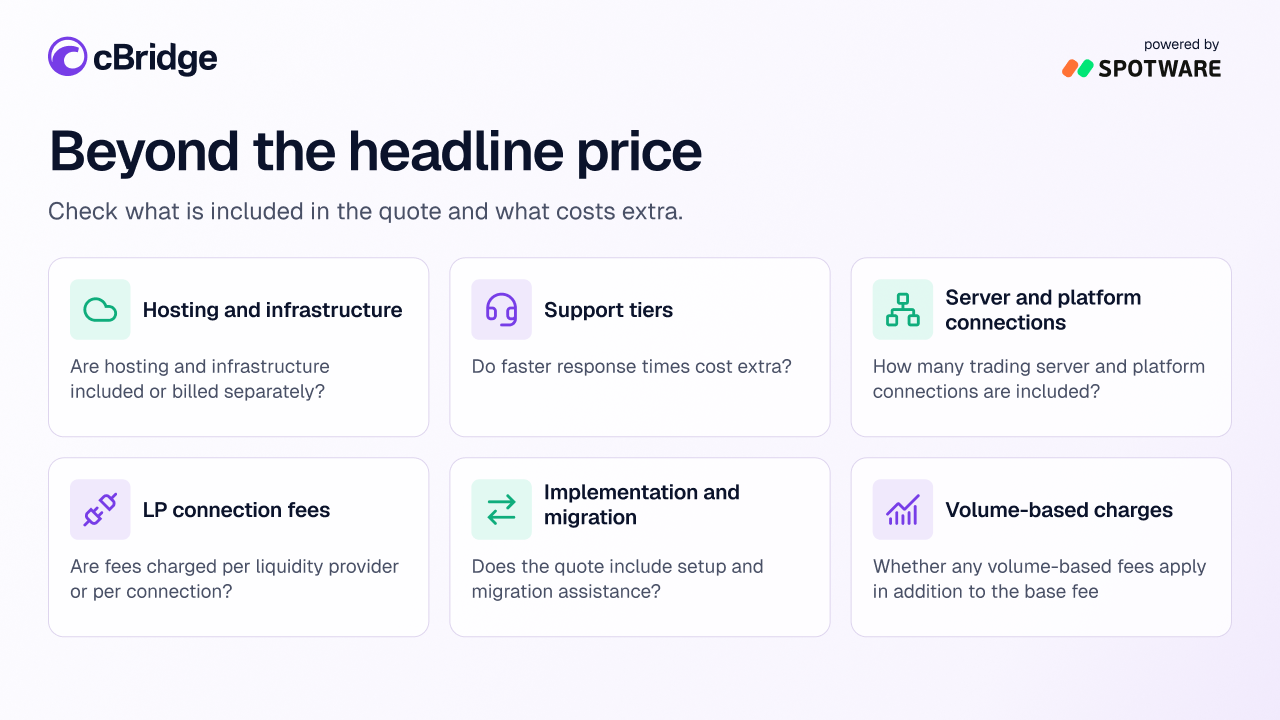
alt description: Liquidity bridge total-cost checklist covering hosting, support tiers, server and platform connections, liquidity provider connection fees, implementation and migration and volume-based add-ons.
Liquidity bridge pricing generally follows one of two models: volume-based fees, which charge per unit of traded volume, or fixed, infrastructure-based fees, tied to servers and connections rather than activity. Neither model is inherently better. Volume-based pricing can suit a smaller broker with modest, predictable flow; the same model becomes considerably more expensive once volume scales, which is precisely the trade-off cBridge's fixed-pricing model is built to avoid.
Whichever model a provider uses, comparing headline prices alone is not a reliable way to evaluate total cost of ownership. A fuller comparison should account for:
Hosting and infrastructure costs, whether bundled or billed separately
Support tiers and whether faster response times cost extra
The number of trading-server or platform connections included
Liquidity provider connection fees, which can apply per provider or per session
Implementation and migration costs, including any professional-services time
Whether any volume-based fees apply in addition to the base fee
PrimeXM publishes a detailed XCore pricing model combining instance, connectivity, volume and transaction fees, while cBridge publishes fixed infrastructure-based pricing tied to the broker's setup. Other providers generally require brokers to request a tailored commercial proposal rather than publishing a complete price list.
To model the cost of your own setup, review cBridge pricing and use the calculator to estimate costs based on your trading servers and liquidity provider connections.
Best fit by broker profile
Multi-platform broker: cBridge and Tools for Brokers both publicly confirm cTrader alongside MT4 and MT5, which matters if you run more than one platform under a single bridge.
MT4/MT5-focused broker: PrimeXM, oneZero and Centroid Solutions each have a long history of MetaTrader-specific bridging and gateway tools.
Broker prioritising institutional infrastructure: Centroid Solutions, oneZero and PrimeXM all publicly reference institutional-grade, low-latency infrastructure and connectivity to multiple liquidity providers.
Broker requiring advanced analytics: Tools for Brokers' Business Intelligence module and PrimeXM's historic log and monitoring tools are the most explicitly documented on this front.
Broker prioritising predictable costs: cBridge's fixed, infrastructure-based pricing is built specifically around removing volume-based cost variability.
These are starting points, not a substitute for confirming fit against your volume, platform mix and internal resources.
For a more detailed decision framework covering pricing, platform support, migration and operational complexity, read How to choose a liquidity bridge in 2026.
Questions to ask during a bridge demo or RFP
1. Which of our specific liquidity providers are already integrated, and what is the cost and timeline to add any that are not?
2. What does the full pricing structure look like once hosting, support, liquidity provider connections and implementation are included?
3. What happens, step by step, if a primary liquidity provider disconnects mid-session?
4. What level of routing and markup customisation is available per symbol, account or trader group?
5. What reporting is available out of the box, and what requires a third-party integration?
6. What does a typical implementation and migration timeline look like for a brokerage of our size?
7. What support commitments are contractually guaranteed, rather than described informally?
8. How is pricing structured if our trading volume doubles within the contract term?
Conclusion and methodology disclosure
There is no single best liquidity bridge provider for every broker. cBridge, Centroid Solutions, FXCubic, oneZero, PrimeXM and Tools for Brokers each publicly emphasise different strengths, from fixed pricing to ultra-low latency to built-in analytics, and each will suit a different combination of platform mix, scale and internal resources.
Want to compare cBridge with your current setup? Start a 30-day cBridge demo to test connectivity, routing and day-to-day workflows before you commit.
FAQs
What is the best liquidity bridge for an FX or CFD broker?
There is no single best provider for every broker. The right choice depends on your trading platforms, liquidity-provider relationships, expected volume, internal operational capacity and whether you prioritise fixed or volume-based pricing.
How should brokers compare liquidity bridge providers?
Evaluate every provider against the same criteria, covering platform support, liquidity provider connectivity, aggregation, routing and failover, monitoring and reporting, risk management, infrastructure, implementation, support and total cost rather than comparing feature lists in isolation.
Which liquidity bridges support MT4, MT5 and cTrader?
cBridge and Tools for Brokers both publicly confirm support for MT4, MT5 and cTrader. Tools for Brokers also publicly confirms TradeLocker support. The remaining providers reviewed confirm MT4 and MT5 support; cTrader compatibility should be confirmed directly with them.
What is the difference between fixed-price and volume-based bridge pricing?
Volume-based pricing charges according to trading volume, so costs rise as activity increases. Fixed, infrastructure-based pricing, the model used by cBridge, is based on servers and connections, so costs do not rise directly with trading volume. Total costs may still change if the infrastructure setup expands.
How many liquidity providers should a bridge support?
This depends on your execution model and risk appetite rather than a fixed number. Brokers running a simple A-Book model may need only one or two liquidity providers while those running more complex aggregation strategies may connect to several.
What should brokers test before selecting a liquidity bridge?
Confirm connectivity with your actual liquidity providers, test routing and failover behaviour under simulated liquidity provider outages and review the reporting output against what your risk and compliance teams actually need.
Can a broker change its liquidity bridge without replacing its trading platforms?
Generally yes. A liquidity bridge sits between the trading platform and liquidity providers so switching providers typically involves reconfiguring connectivity and routing rather than replacing MT4, MT5 or cTrader itself. Migration scope still varies by provider. For a step-by-step look at parallel deployment, configuration mapping and phased cutover, read How to switch liquidity bridge providers without disrupting trading.
How often should a liquidity bridge comparison be updated?
Quarterly is a reasonable cadence, given how frequently providers update integrations, features and commercial terms. This article is reviewed on that basis.
Keep reading

ما هو جسر السيولة؟ دليل عملي لوسطاء الفوركس وعقود الفروقات
تعرّف على جسر السيولة لوسطاء الفوركس وعقود الفروقات، وكيف يربط منصات التداول بمزودي السيولة ويدير التسعير والتوجيه والتنفيذ.
 cBridge team
كيفية تغيير مزود جسر السيولة دون تعطيل التداول
هل تفكر في تغيير مزود جسر السيولة؟ إطار عملي لترحيل جسر السيولة بأمان باستخدام النشر المتوازي ومواءمة الإعدادات والانتقال التدريجي.
cBridge team
تسعير جسر السيولة: لماذا ترتفع تكاليف الوسيط مع زيادة حجم التداول
تعرّف على سبب ارتفاع تكاليف جسر السيولة مع نمو حجم التداول، وكيف يوفر cBridge تسعيراً ثابتاً قائماً على البنية التحتية من دون رسوم على حجم التداول.
cBridge team