
Every price your clients see, every order they place, every fill they receive and every execution report your team pulls passes through one piece of infrastructure: the liquidity bridge. It sits quietly in the middle of the operation, which is exactly why it is easy to underestimate when the time comes to choose, or change, a provider.
For a CEO running an FX/CFD brokerage or prop firm, this decision rarely gets framed as strategic. It tends to surface reactively via a contract renewal, a surprise invoice after a strong trading month, a new platform you need to support. By the time “Should we switch?” gets asked properly, the business has usually outgrown the assumptions behind that original choice.
That reactive pattern is worth breaking. The bridge you run in 2026 will shape your execution quality, cost base, operational workload, risk exposure and client experience for as long as you run it. Below is a practical framework for evaluating providers, built around the criteria that predict whether a bridge will still fit in 5+ years, not just on the day you sign.
Why this decision carries more weight than usually assumed
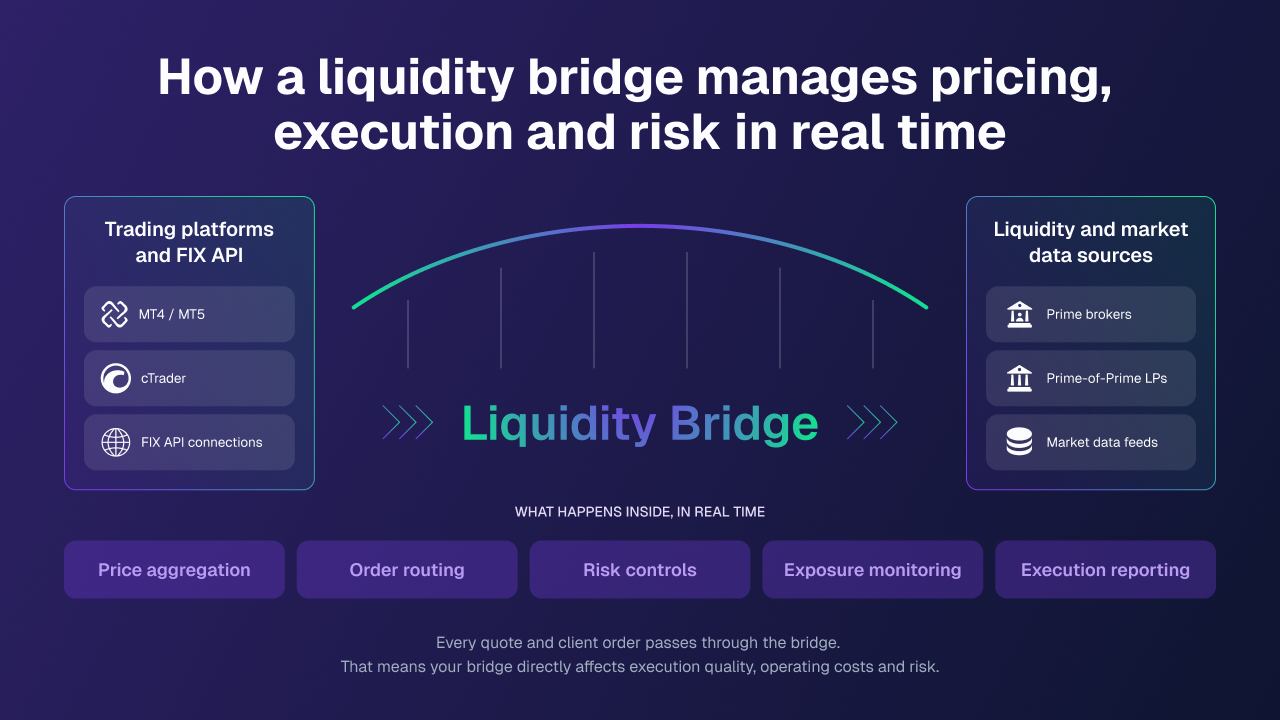
A liquidity bridge connects your trading platforms (MT4, MT5, cTrader or FIX API Takers) to your liquidity providers, handling price aggregation, order routing, risk controls, exposure monitoring and reporting, often all in real time.
Get it wrong, and the consequences do not stay contained. Execution quality affects client retention, pricing structure affects profitability as you scale, and operational complexity determines headcount. Switching later, once dependent on a particular configuration, is rarely simple. This is why the decision deserves more rigour than a feature comparison spreadsheet.
Do not compare bridges on feature lists alone
It is tempting to default to feature parity as the deciding factor. Whoever has the longest capability list wins. But a long feature list does not automatically mean the best fit.
Unused functionality does not sit idle, it still comes with a cost in operational overhead, configuration complexity or price. A bridge that focuses on the functionality you actually need, without unnecessary complexity, and that your team can run with confidence can outperform a feature-rich alternative in practice.
The right question is not "Which bridge can do the most?" It is "Which bridge does what we need, in a way our team can run well?"
The criteria that actually matter
Strip away the marketing language, and most evaluations come down to the same factors:
Evaluation criterion | What to ask |
|---|---|
Pricing model | Volume-based, fixed/infrastructure-based or hybrid? How does cost scale as volume grows? |
LP aggregation | How does the bridge handle multiple LPs: aggregation, failover, and price/depth across feeds? |
Routing flexibility | Can routing rules be configured per symbol, client group or server without engineering support? |
Risk controls | Built-in or bolted on? |
Monitoring & reporting | Can your team see exposure and billing data without manual exports? |
Operational complexity | How many people does it take to run day to day? |
Migration | What is actually involved in moving your existing configuration across? |
Support | What are real response times and SLAs, not just the ones on the data sheet? |
Contract flexibility | Minimum term and what does exiting look like? |
Ecosystem fit | Does it match your platforms, liquidity setup, team and growth plans? |
No single row in the table above should decide the outcome alone. Fit comes from how they combine for your specific brokerage.
Pricing: the factor that compounds over time
The pricing model deserves the closest attention because its impact compounds as you grow.
Most established providers charge on a volume basis, typically $1–$2 per million traded. That feels manageable at smaller volumes, but run the numbers forward: a brokerage processing 10 billion in monthly volume at $1 per million pays roughly $10,000 a month in fees alone, with no ceiling as volume rises without strenuous negotiation. Growth thus directly inflates this cost line.
The alternative is fixed, infrastructure-based pricing, tied to servers and connections rather than turnover. Costs are not directly linked to trading volume and remain predictable within the selected infrastructure setup, and the more you grow, the more favourable the economics become relative to a volume-based model.
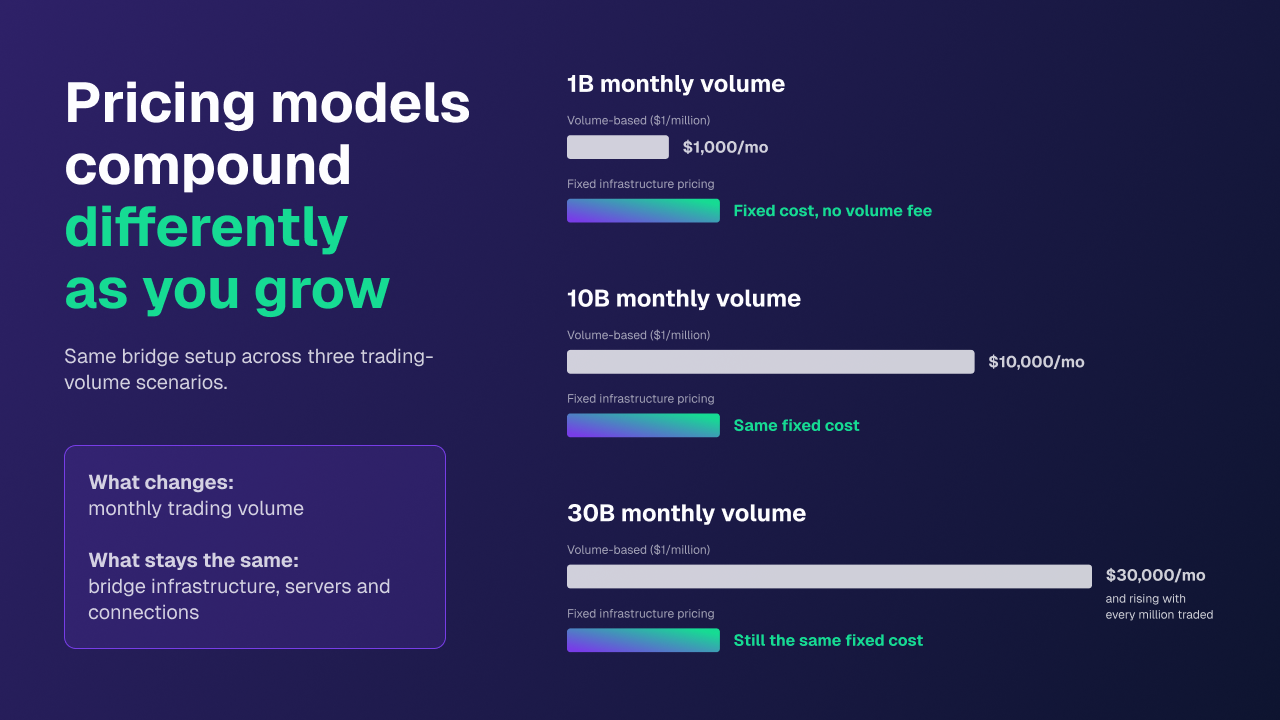 Neither model is wrong in itself. Volume-based pricing can suit modest, stable volume while avoiding fixed overheads. Fixed pricing tends to suit brokerages scaling up or wanting cost certainty for budgeting. The mistake is choosing a model without modelling your own growth against it first.
Operational complexity and ease of use
Deep functionality can be exactly what a large brokerage with a dedicated dealing desk needs. For a leaner team, that same depth can become a liability (every extra layer is something staff must learn, maintain and troubleshoot).
A sales demo shows a bridge at its best, run by people who have used it for years. The real test is how it performs in your team's hands, months after go-live. Look for whether settings are visibly connected to each other or scattered across disconnected screens, whether issues can be diagnosed in-platform or always need a support ticket, and whether cross-setting validation flags conflicts (duplicate feeds, orphaned rules, routing that silently never fires) before they cause problems. Run the demo with your own dealer, not the vendor's, and watch how long it takes them to find something without help.
Operational dependency and knowledge continuity
The bigger risk with a liquidity bridge often has less to do with the contract and more to do with how much operational knowledge lives in just one or two people's heads.
Symbol mappings, routing rules, risk parameters and the day-to-day judgement calls that keep a bridge running well are frequently understood in full by only the person or two who set them up. If those people leave the company, losing that knowledge can be a far bigger risk to the business than switching providers ever would be.
The reassuring part is that moving from one bridge to another does not need to be a major undertaking. Established technology providers typically offer migration scripts and structured onboarding processes that transfer settings, mappings and routing logic across efficiently. Provided the new provider brings the right tools, documentation and migration support, the operational and technical risks of switching can be significantly reduced.
Ecosystem fit ties it together
A bridge needs to fit the platforms you run, the liquidity providers you work with, your team's size, and where your brokerage is heading. A bridge that is an excellent fit for one outfit might be overkill for another. Equally, a bridge chosen only for short-term requirements can become a constraint if it cannot support future platform, liquidity or operational expansion.
The honest trade-off: there is no single best bridge
It would be convenient to end with one recommendation. There is not one, and any article claiming otherwise deserves your scepticism.
Some brokerages need highly specialised functionality for complex operating models. Others prioritise predictable pricing, multi-platform support, operational clarity and scalability. In many cases, these requirements overlap rather than belong to separate broker categories.
This is where a provider like cBridge fits into the conversation. It is a platform-agnostic liquidity bridge connecting MT4, MT5, cTrader and FIX API Takers to multiple liquidity providers, built on fixed, infrastructure-based pricing rather than volume fees. That pricing model is not only relevant to growing brokerages either: it can bring substantial cost efficiencies to enterprise brokers too, and cBridge's functionality and technical foundation are built to support larger operations. It is backed by the wider Spotware development and support organisation, the same team behind cTrader, with 16 years of experience building and supporting trading technology.
For brokerages prioritising predictable costs, simpler operations and infrastructure that scales without re-architecting, it is a serious option to include in an evaluation.
It is not the universal answer for every brokerage. Whether it (or any other provider) fits depends entirely on where your brokerage sits against the criteria above.

A practical decision framework
Start from your own brokerage, not a list of providers:
What is the current pain, specifically? Cost unpredictability, operational overhead, platform limits or support responsiveness each point to different priorities.
What is your monthly volume, and where is it heading? This determines whether volume-based or fixed pricing favours you, and by how much.
Which platforms do you run and which might you add? Multi-platform support matters if MT5, cTrader or another trading platform is on your roadmap.
How big and technical is your operations team? This shapes how much complexity you can realistically absorb.
How exposed are you to pricing risk as you grow? Model bridge costs double and triple your current volume under each pricing model.
What would migration cost you now versus in two years? Earlier moves tend to be less disruptive than later ones.
How much contractual flexibility do you need? Match terms to how confident you are in the relationship long-term.
Score providers against your own answers, not a generic checklist. The provider that wins on industry norms is not necessarily the one that serves your brokerage well eighteen months from now.
Conclusion
Choosing a liquidity bridge is not a one-off procurement task. It is a decision that touches execution quality, cost structure, operational workload, risk management and client experience for as long as the bridge is in place. Start with your own pain points, volume trajectory and team capacity, then evaluate providers, including cBridge, against that picture rather than the other way round.
For brokers weighing cBridge specifically, the main points worth carrying into that evaluation are:
Fixed, infrastructure-based pricing
Costs that are not tied to trading volume
Support for MT4, MT5, cTrader and FIX API Taker connections
Multi-LP connectivity
Routing and execution control
Operational visibility
Scalable infrastructure
Backing from the wider Spotware development and customer support teams
If you are reviewing your current setup, it is worth comparing it against this framework before your next renewal date arrives.
Book a cBridge demo to compare your current setup with an infrastructure-based pricing model that does not charge by trading volume.
FAQs
What does a liquidity bridge actually do?
It connects a broker's trading platforms (MT4, MT5, cTrader or FIX API Takers) to one or more liquidity providers, handling price aggregation, order routing, risk controls, exposure monitoring and execution reporting in real time.
What is the difference between volume-based and fixed-price liquidity bridges?
Volume-based pricing charges per unit of traded volume, typically $1–$2 per million, so costs rise with volume. Fixed, infrastructure-based pricing charges according to servers and connections, keeping costs stable regardless of volume.
Is a feature-rich bridge always the better choice?
Not necessarily. Extensive functionality suits large, complex brokerages, but the same depth can create unnecessary operational overhead for smaller or growing brokerages that do not need every available feature.
How disruptive is switching liquidity bridge providers?
It depends on the provider and the migration support offered. A guided process with configuration mapping, migration scripts and structured onboarding keeps disruption low.
Is cBridge the best liquidity bridge for every broker?
No single bridge is the best fit for every broker. cBridge suits brokerages prioritising fixed pricing, operational simplicity and flexible infrastructure.
Keep reading

Best liquidity bridge providers for brokers in 2027: a practical comparison
Comparing liquidity bridge providers? See how cBridge, oneZero, PrimeXM, FXCubic, Centroid Solutions and Tools for Brokers stack up against the same public criteria.
 cBridge team
What is a liquidity bridge? A practical guide for FX and CFD brokers
Learn what a liquidity bridge does, how it connects trading platforms to liquidity providers, and how brokers use it for pricing, routing and execution.
cBridge team
How to switch liquidity bridge provider without disrupting trading
Thinking about switching liquidity bridge providers? A practical framework for migrating safely, using parallel deployment, configuration mapping and phased cutover.
cBridge team