
Switching liquidity bridge providers is not a decision to make lightly. It touches pricing, execution, order routing, liquidity connectivity, reporting and risk controls. In other words, it has ramifications for the operational core of your brokerage. Any framework that pretends otherwise is not being straight with you.
That honesty matters, because it’s precisely why so many brokers who are unhappy with their current setup never actually switch. The pain of staying is a known entity and feels manageable. The risk of moving feels open-ended. Faced with that comparison, inertia usually wins, even when the numbers say it shouldn't.
Talk to our team about a migration assessment for your current bridge setup.
Why brokers consider changing their liquidity bridge
Changing liquidity bridge providers affects pricing, routing, connectivity, reporting and exposure management. This makes migration a significant operational project, but it does not have to be treated as a single overnight cutover.
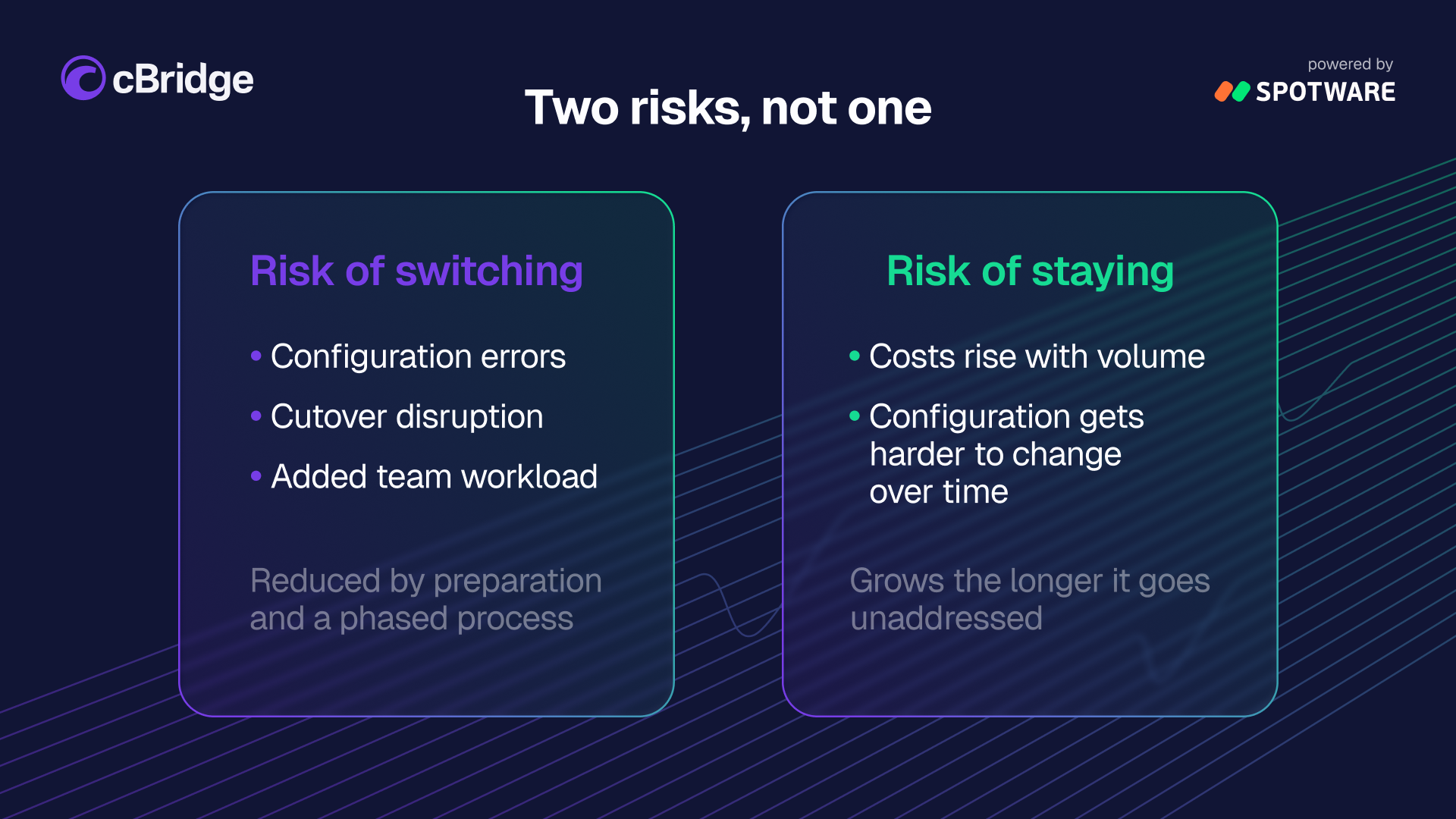
The reasons are consistent across the industry. Teams worry about downtime during a live trading window. They worry about configuration mistakes (a mismapped symbol, a routing rule that fires on the wrong server, a risk parameter that doesn’t carry across cleanly). They worry about disrupting clients who notice nothing about infrastructure until something goes wrong with it. And they worry about the internal workload a migration adds on top of a team that’s already stretched.
None of these concerns are irrational. A bridge sits in the middle of every price your clients see and every fill they receive. Getting a migration wrong has consequences that reach clients directly.
How to choose a liquidity bridge: A decision framework for brokers
The hidden cost of staying put
What is less often said out loud is that brokers don’t always stay with a bridge because they’re happy with it. They stay because the perceived risk of switching feels larger than the pain of continuing as things are.
That’s a lock-in effect, even if no contract enforces it directly. The current setup keeps its place not on merit, but because moving away from it looks harder than living with its shortcomings. And the longer a broker operates on that basis, the more that judgement gets treated as settled fact rather than something worth revisiting.
Before deciding whether to switch, it’s worth auditing your current bridge setup on its own terms. Most brokers have never formally reviewed their configuration. They inherited it, extended it over time, and never stepped back to assess it as a whole. A short internal audit, covering pricing logic, routing rules, symbol mapping, risk parameters and reporting, gives a clear baseline of what actually exists today rather than what the team assumes exists.
We have put together a 15-item checklist that dealing desk managers can use to run this audit in under an hour. It won’t tell you whether to switch, but it will tell you exactly what you’re switching from, which makes every decision after it more informed.

Why the problem compounds over time
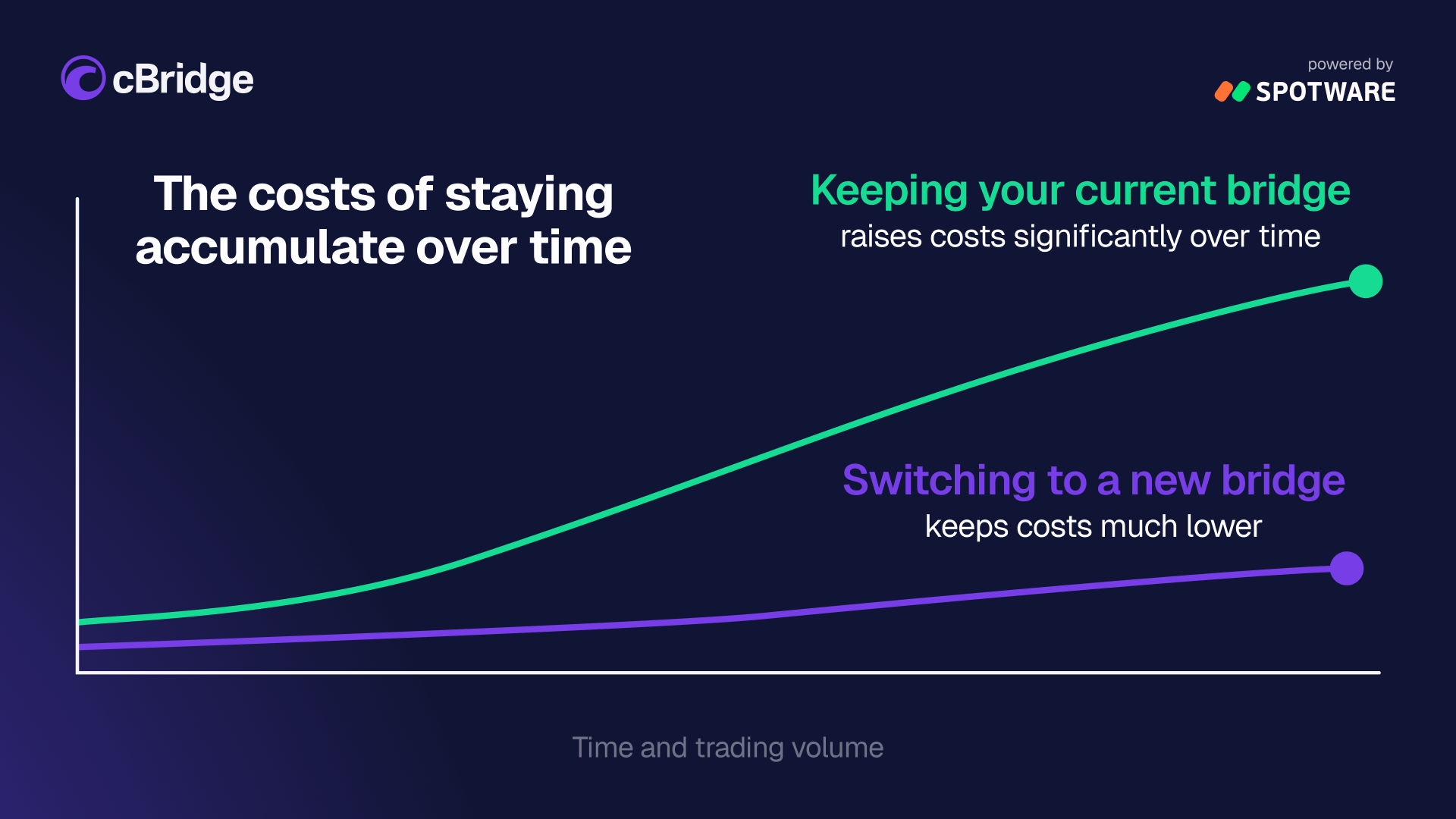
The case for staying put also tends to get weaker, not stronger, the longer it goes unexamined. As trading volume grows, volume-based costs grow with it, often without a ceiling. As the business adds symbols, liquidity providers, servers or platforms, configuration becomes more deeply embedded and harder to unpick. And a setup built for an earlier stage of the business can start to actively limit the next one, whether that is a new platform, a new region or a new liquidity relationship.
At that point, the original decision to stay put stops being a neutral choice and starts becoming an active constraint on growth. The risk calculation that once favoured staying can quietly flip, and most brokerages only notice once a contract renewal or a surprise invoice forces the question.
A migration approach that doesn’t require a single overnight switch
The good news is that migration risk is manageable, provided it’s treated as a structured process rather than a single high-stakes cutover.
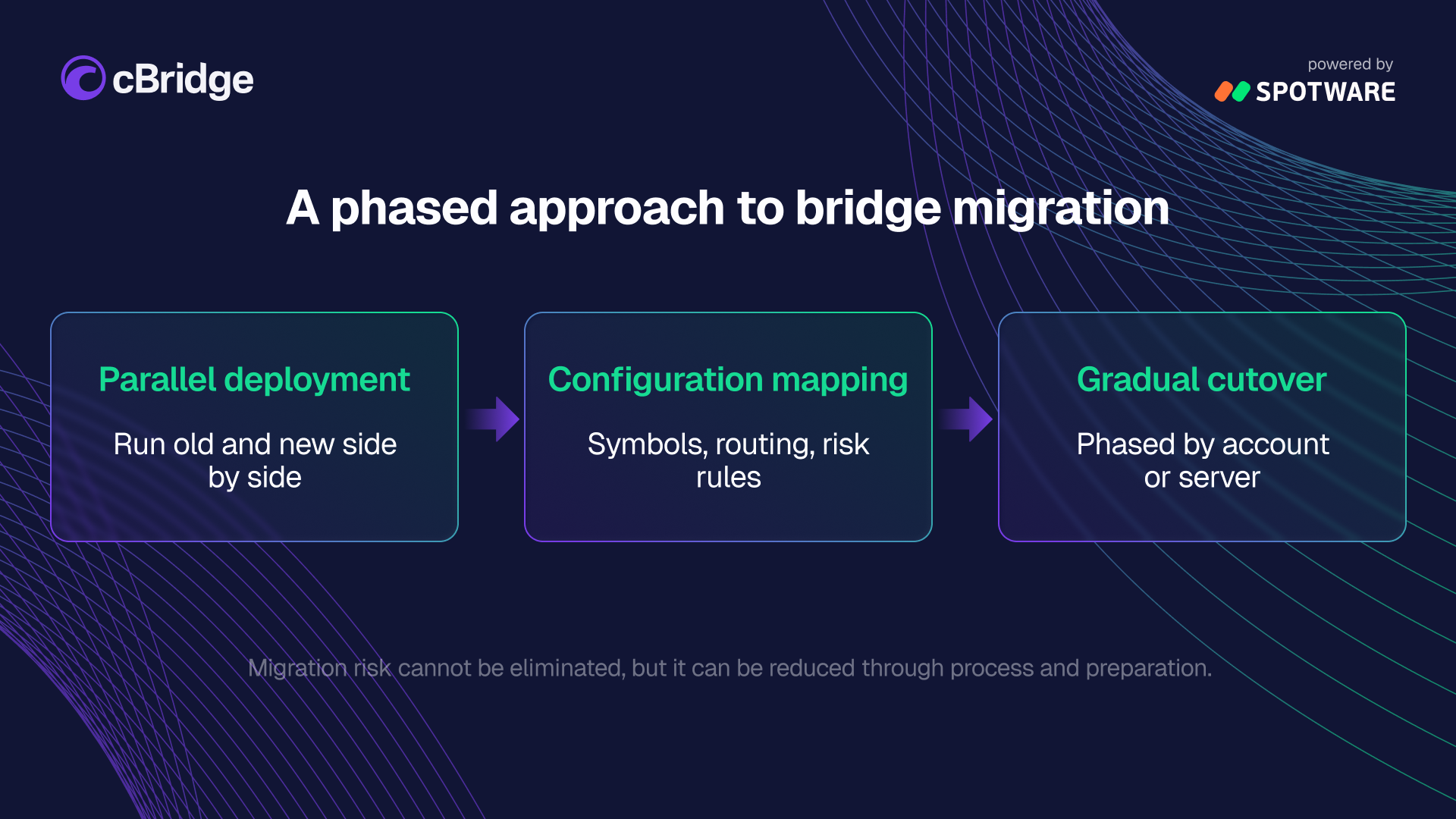
Parallel deployment. A new bridge environment can be stood up alongside the existing one, rather than replacing it outright. This allows a broker to test pricing, execution and routing behaviour under real conditions before a single live account is moved across. Running two environments side by side turns migration from a leap of faith into something that can be observed and verified first.
Configuration mapping. Symbols, liquidity provider connections, routing logic, pricing rules and risk parameters all need to be mapped clearly from the old environment to the new one before anything goes live. This is the step that most directly prevents the mismatched symbol or misfiring routing rule that teams worry about. Done properly, it turns migration from guesswork into a documented, checkable process.
Gradual cutover. Rather than moving an entire client base and trading volume in one move, a phased transition, by account group, by symbol set or by server, gives the team room to confirm each stage is working before the next one begins. This reduces both the operational pressure on internal teams and the exposure if something does need adjusting along the way.
Together, these steps don’t eliminate migration risk. No credible process can promise that. What they do is convert an undefined risk into a managed one, with checkpoints along the way rather than a single point of failure.
Where cBridge fits into a migration
The main advantage of migrating to cBridge is that Spotware handles a large share of the work. Spotware uses automated scripts to convert and map those settings to the configuration structure used by cBridge. The team also helps install the MT4 plugin and MT5 Gateway and migrate existing exposure. This reduces manual configuration and the risk of human error, while easing the workload on the broker’s internal team and makes the transition easier to plan and control.
cBridge is built with this kind of phased approach in mind. The 30-day free demo gives brokers time to evaluate cBridge before committing, while the Spotware team assists with setup transfer, configuration mapping, installation and exposure migration.
One cBridge environment can connect MT4, MT5, cTrader and FIX API Takers to multiple liquidity providers, allowing multi-platform brokers to manage connectivity, pricing and routing through one bridge. More than 50 ready liquidity provider integrations reduce the connectivity work involved in a migration.
None of this makes switching a formality. It means a broker considering a move has a lower-risk way to start:
Trial the environment
Map the configuration
Move in stages
And only commit once the new setup has proven itself against the old one.
The real question is not only whether to switch
Migration risk deserves to be taken seriously, and no responsible provider will tell a broker otherwise. But it is worth weighing against the other risk in this picture: staying with a setup where cost keeps rising with volume, configuration keeps getting harder to change, and the platform itself starts to limit what the business can do next.
Switching carries risk. So does standing still. The difference is that switching risk can be reduced through preparation, parallel testing and a phased process. The risk of staying tends only to grow the longer it goes unaddressed.
Request a migration assessment to see what moving to cBridge would actually involve for your setup, or try cBridge free for 30 days to test it directly alongside your current bridge.

FAQ
How long does a liquidity bridge migration take?
A migration to cBridge can be completed in as little as five days. The exact timeline depends on the complexity of the existing setup, including the number of trading servers and LP connections, the configuration logic to be mapped, platform-side installation requirements and the exposure to be transferred. Spotware assesses the current environment in advance and confirms the migration scope and schedule before work begins.
Can a broker switch bridge providers without downtime?
A parallel deployment can significantly reduce downtime risk, but the exact approach depends on the broker’s trading platforms, existing bridge configuration and required platform-side changes.
What happens to open positions during bridge migration?
The migration plan must distinguish between positions held on the trading platform and exposure recorded in the bridge. When migrating to cBridge, Spotware supports exposure migration and reconciliation as a separate part of the transition process.
What are the risks of changing a bridge provider?
The main risks are configuration errors, such as mismapped symbols or routing rules, operational disruption during cutover, and the internal workload a migration places on the team. These risks are real, but they are also the ones a structured process, including configuration mapping and a phased rollout, is specifically designed to reduce.
Can a broker run two liquidity bridges in parallel?
Yes. Parallel deployment (running an existing bridge and a new one side by side) is one of the most effective ways to reduce migration risk, since it allows execution and routing behaviour to be verified under real conditions before any client volume is moved across.
Keep reading
What is a liquidity bridge? A practical guide for FX and CFD brokers
Learn what a liquidity bridge does, how it connects trading platforms to liquidity providers, and how brokers use it for pricing, routing and execution.
 cBridge team
Liquidity bridge pricing: why broker costs rise with trading volume
Learn why volume-based liquidity bridge pricing increases broker costs as trading activity grows, and how cBridge provides predictable pricing with no volume fees.
cBridge team
How to choose a liquidity bridge in 2026: A decision framework for brokers
Comparing liquidity bridge providers in 2026? Use this broker decision framework to evaluate pricing, platform support, LP connectivity, migration and operational complexity.
cBridge team