
A liquidity bridge sits between an FX or CFD broker’s trading platform and its liquidity providers. It takes incoming price feeds, turns them into tradeable quotes on your platform, and routes client orders back out for execution. Get it right and dealing, risk and finance all work from the same accurate picture. Get it wrong, and the cracks show up as bad fills, stale prices and reconciliation headaches nobody can explain.
This guide walks through what a liquidity bridge does, who inside a brokerage relies on it day to day and how functionality expands from a direct FIX connection to a standalone gateway, a standalone aggregator, a combined gateway, aggregator and risk setup, and a full liquidity bridge. If you already understand the basics and want a framework for evaluating providers, our guide to how to choose a liquidity bridge covers that ground.
What a liquidity bridge actually does
A forex liquidity bridge connects a broker’s trading platform to one or more liquidity providers and manages what happens to prices, orders and execution data in between.
That means handling connectivity to each LP, translating between different protocols and data formats, mapping symbols so that “EURUSD” on one feed matches “EUR/USD” on another, aggregating multiple price streams into a single tradeable quote, applying your markup, routing the resulting order to the right destination, confirming execution and keeping a full record of what happened. Miss any one of those steps and something downstream breaks, usually somewhere a client notices before you do.
The path from LP price feed to client fill
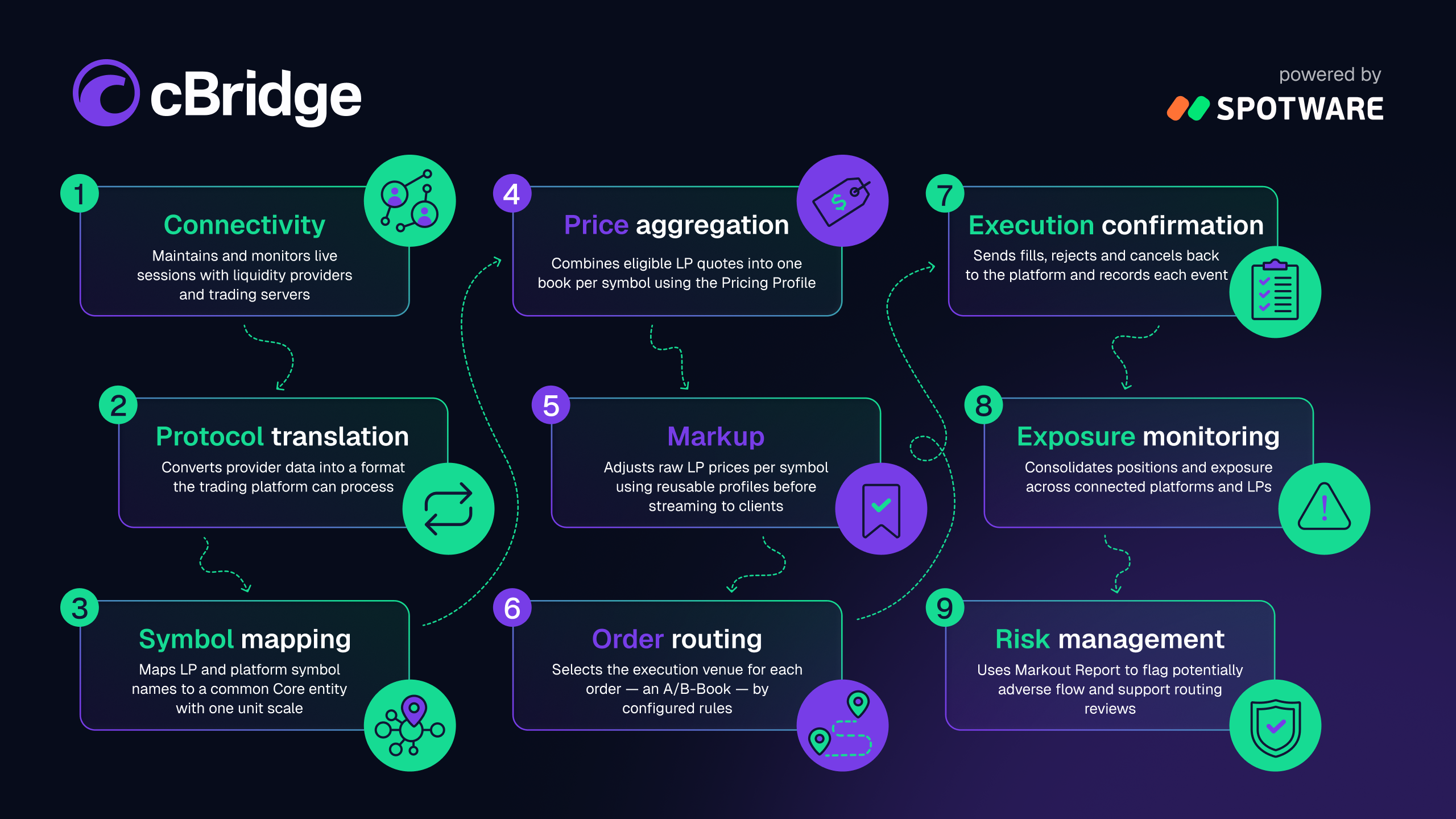
How a liquidity bridge moves prices from LP feed to client fill. It helps to follow a single price all the way through the system, because this is the sequence a liquidity bridge is built to manage.
Connectivity. The bridge maintains a live connection to each liquidity provider, typically over FIX API, and keeps that connection monitored so a dropped feed doesn't silently leave you quoting stale prices.
Protocol translation. Liquidity providers don't all speak the same language. One might stream FIX, another a proprietary API. The bridge translates every incoming feed into a format your trading platform understands, whether that's MT4, MT5, cTrader or an in-house system.
Symbol mapping. The same instrument can appear under different tickers, tick sizes and contract specifications across providers. Symbol mapping keeps EURUSD from one LP aligned with EURUSD from another, so aggregation further down the chain is comparing like with like.
Price aggregation. With multiple LP feeds coming in, the bridge builds a composite book and streams out the best available bid and ask, refreshed as fast as the underlying feeds update.
Markup. Before that price reaches a client, the bridge applies your pricing rules, whether that's a fixed markup, a variable spread by instrument or different terms by account group.
Routing. When a client places an order, the bridge applies the configured routing rules to determine the destination: straight through to an LP, internalised against your own book or split across both, depending on the rules you've set for that instrument or client type.
Execution reporting. Once an order is executed, the bridge returns the execution result to the platform and records it for monitoring, reporting and reconciliation.
Exposure visibility. Many bridges also consolidate exposure data from connected trading platforms and liquidity providers. The available level of detail varies by product.
Risk management. Execution data can also support post-trade risk analysis. For example, Markout Report measures how the market moves after each trade, highlights potentially adverse flow and assigns explainable risk scores to accounts. This helps dealing and risk teams investigate recurring patterns and review routing decisions before losses accumulate.
Who inside a brokerage actually uses the bridge
A liquidity bridge isn't a dealing-desk tool that the rest of the business ignores. Several teams depend on it, and each one feels it differently when something goes wrong.
Dealing relies on the bridge for accurate, current pricing and routing logic. Without it, dealing works from a delayed or incomplete picture of the market.
Risk uses the exposure visibility the bridge provides to hedge in real time. Without consolidated exposure data across LPs and instruments, hedging becomes reactive rather than active.
Finance depends on the execution records the bridge keeps for reconciliation, LP fee calculations and reporting. When records don't match across systems, finance usually finds out last and has to trace the problem backwards.
Support needs a reliable trade history to answer client queries about fills, slippage and pricing. A gap in execution reporting turns a five-minute query into a drawn-out investigation.
From direct FIX connectivity, gateway, aggregator to a full liquidity bridge
These setups are listed in order of increasing functional scope: direct FIX connection, standalone gateway, standalone aggregator, gateway + aggregator + risk, then liquidity bridge. Gateway and aggregation functions can be offered as standalone solutions or included as components of a bridge. The sequence is a practical way to understand the functions involved, rather than a mandatory upgrade path; exact capabilities vary by product.
Setup | Core functionality | What remains outside its scope |
|---|---|---|
Direct FIX connection | Exchanges price, order and execution messages directly between the broker's system and an LP. | Aggregation, routing rules, risk controls and operational monitoring must be provided by other components or built in-house. |
Standalone gateway | Connects a trading platform to an LP and adapts the required protocols or interfaces. | Multi-LP aggregation, risk controls and consolidated reporting are not inherent to connectivity alone. |
Standalone aggregator | Combines prices and market depth from multiple LPs into a consolidated book; may also support order routing. | Platform gateways, risk controls and operational reporting may require separate components. |
Gateway + aggregator | Combines platform-to-LP connectivity, multi-LP aggregation and routing in a modular setup. | The components may still need integration, shared configuration and consolidated monitoring and reporting. |
Liquidity bridge | Integrates gateway connectivity, aggregation, pricing, routing and risk functions with centralised monitoring and reporting. | The bridge supplies the technology, not the liquidity itself. LP onboarding and commercial terms remain separate. |
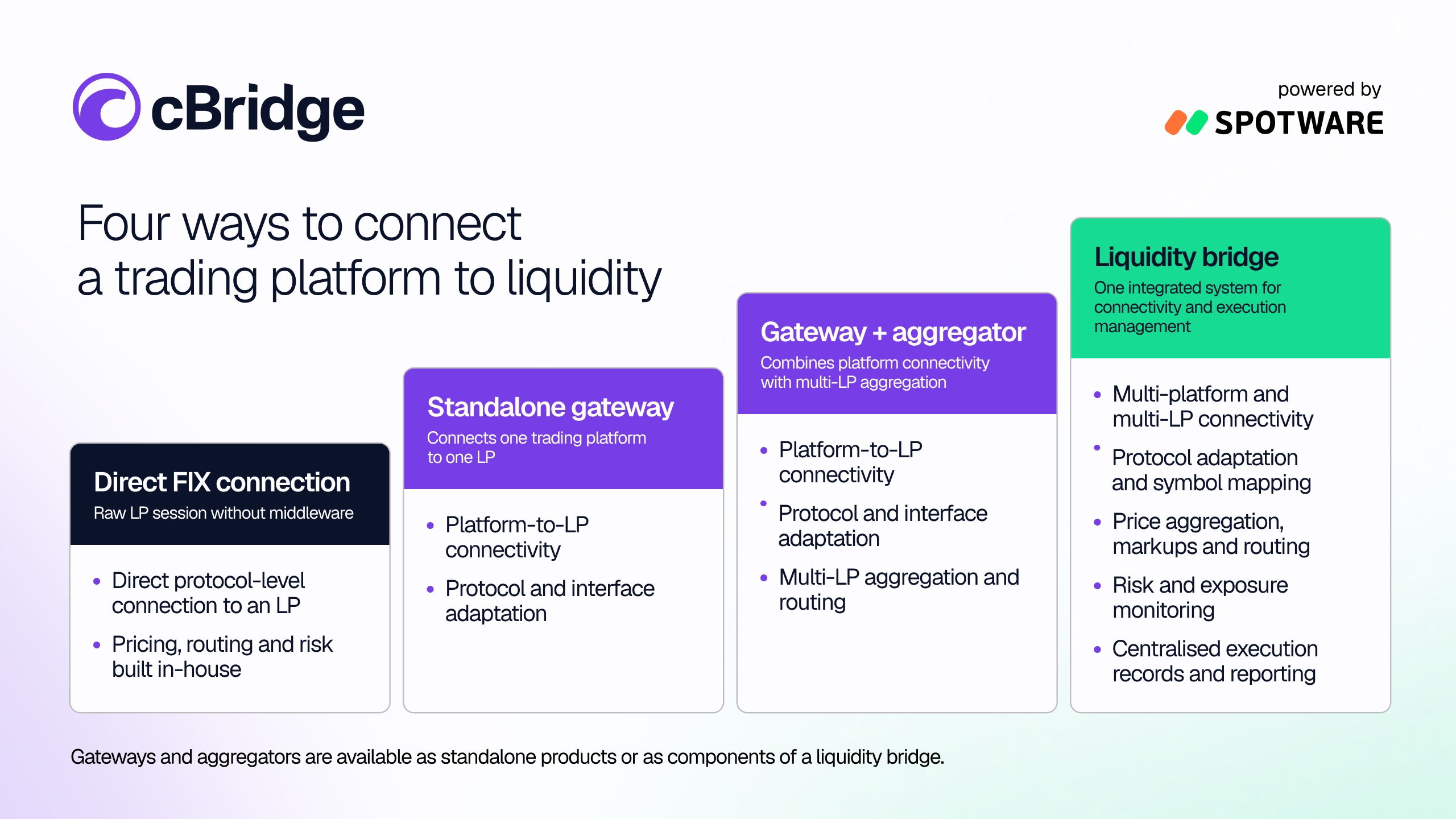
A liquidity bridge brings gateway connectivity, aggregation and risk functions into a broader operational system, with routing, monitoring and reporting managed together. A standalone gateway or aggregator covers a narrower part of that workflow. Combining those components with risk tools expands the setup, but does not automatically provide the unified configuration, execution records and operational visibility of a full bridge. Some platforms already provide parts of this functionality, so the right setup depends on what your infrastructure can already do.
cBridge as a working example
cBridge shows how these functions work together in a multi-platform liquidity bridge. It connects MT4, MT5, cTrader and FIX API environments to multiple liquidity providers, bringing gateway connectivity, price aggregation, markup, routing and risk management into one system, alongside exposure monitoring and execution reporting.
For a broker running more than one trading platform, that centralisation is the practical benefit: one set of pricing rules, one exposure view and centralised execution records, instead of managing aggregation and routing separately for each platform a client might use. Dealing, risk and finance all draw on the same underlying data regardless of which platform a trade originated on.
A connection to cFinancial, an institutional liquidity provider, is included with cBridge at no additional connection cost. This gives brokers a ready-made route to an LP alongside cBridge's aggregation, routing and risk tools. cFinancial's liquidity services are subject to separate onboarding and commercial terms.
Do you need a separate liquidity bridge?
Not automatically. The right setup depends on how many LPs and platforms you connect, which gateway, aggregation and risk functions are already available, and how much integration work you can manage in-house. A direct FIX connection or standalone gateway may be enough for a simple setup with one LP. A standalone aggregator adds multi-LP pricing, while a combined gateway, aggregator and risk setup covers more of the workflow. As requirements expand across platforms and LPs, a full liquidity bridge can bring those functions under centralised configuration, monitoring and reporting.
FAQ
What is a liquidity bridge?
A liquidity bridge is the system that connects a broker's trading platform to its liquidity providers, managing everything from price aggregation to order routing and execution reporting.
Is a liquidity bridge the same as a standalone aggregator?
No. A liquidity aggregator combines price feeds from multiple liquidity providers into one composite book. A liquidity bridge can include aggregation, but it also manages platform connectivity, protocol translation, symbol mapping, markup, routing, execution reporting and exposure visibility.
How does a forex liquidity bridge work?
It takes incoming price feeds from one or more LPs, translates and aggregates them into a single tradeable quote, applies markup and routes client orders back out for execution, while logging the full trade record.
Do all brokers need a liquidity bridge?
No. The need depends on how many LPs and platforms a broker runs. A simple, single-LP, single-platform setup can operate without one; a broker connecting multiple platforms to multiple providers generally needs the consolidated view a bridge provides.
What is the difference between a liquidity bridge and a standalone gateway?
A standalone gateway provides platform-to-LP connectivity and adapts the relevant protocols or interfaces. Gateway functionality can also be built into a liquidity bridge. A full bridge combines it with aggregation, routing, risk controls and operational reporting; the exact feature set depends on the product.
Does a liquidity bridge aggregate prices from multiple providers?
Yes, price aggregation is a core function, but it's one part of a broader path that also includes protocol translation, routing and execution reporting.
Can one liquidity bridge connect MT4, MT5 and cTrader?
Some bridges can. cBridge supports MT4, MT5, cTrader and FIX API Taker environments through one central system. An MT4 liquidity bridge and an MT5 liquidity bridge function can sit within the same system, alongside cTrader and FIX API connectivity, so a broker running multiple platforms manages pricing and routing centrally.
Does a broker need a bridge when using FIX API?
Not necessarily. A direct FIX connection exchanges price, order and execution messages with an LP. Aggregation, routing rules, risk controls and operational monitoring still need to be provided by the broker's system or additional components. A bridge brings those functions together when direct connectivity alone does not cover the broker's requirements.
How much does a liquidity bridge cost?
Costs vary by provider, LP count and platform setup. See our pricing guide for a full breakdown.
Next steps
If your brokerage is weighing up whether to run a bridge, and which one, our guide to how to choose a liquidity bridge in 2026 sets out a decision framework. If you've already got a bridge in place and are considering a change, switching liquidity bridge provider without disrupting trading covers how to do that without downtime.
To see how cBridge handles the path described above, download the cBridge eBook or test cBridge free for 30 days.
Keep reading
Best liquidity bridge providers for brokers in 2027: a practical comparison
Comparing liquidity bridge providers? See how cBridge, oneZero, PrimeXM, FXCubic, Centroid Solutions and Tools for Brokers stack up against the same public criteria.
 cBridge team
How to switch liquidity bridge provider without disrupting trading
Thinking about switching liquidity bridge providers? A practical framework for migrating safely, using parallel deployment, configuration mapping and phased cutover.
cBridge team
Liquidity bridge pricing: why broker costs rise with trading volume
Learn why volume-based liquidity bridge pricing increases broker costs as trading activity grows, and how cBridge provides predictable pricing with no volume fees.
cBridge team