
Liquidity bridge pricing: why broker costs rise with trading volume
Growth should improve a broker’s economics. Under volume-based liquidity bridge pricing, however, the more clients trade, the more the bridge invoice rises.
For CEOs of new and established FX and CFD retail brokers, this creates a direct link between commercial success and broker infrastructure costs. A stronger acquisition campaign, an active IB network, higher market volatility or a small number of high-volume clients can all increase liquidity bridge fees, even when the underlying server and liquidity setup have not changed.
The question is simple: why should the bridge bill rise every time the business grows?
This guide explains how volume-based bridge pricing works, why it can become a growth penalty, and how infrastructure-based pricing provides a more predictable alternative. cBridge addresses this problem through fixed, infrastructure-based pricing with no volume fees, linking cost to the broker’s required setup rather than every increase in trading activity.
Calculate your potential bridge cost savings.
At a glance
Volume-based bridge pricing charges the broker based on the volume traded, typically through a per-million bridge fee.
Infrastructure-based pricing links cost to the bridge setup, including the bridge server, Taker connections to trading environments and LP connections.
cBridge uses infrastructure-based pricing, helping brokers keep bridge costs predictable as trading volume grows.
Why liquidity bridge costs increase with trading volume?
A liquidity bridge connects a broker’s trading environment to one or more liquidity providers. It carries prices, orders and execution data between the trading server and the liquidity side of the setup.
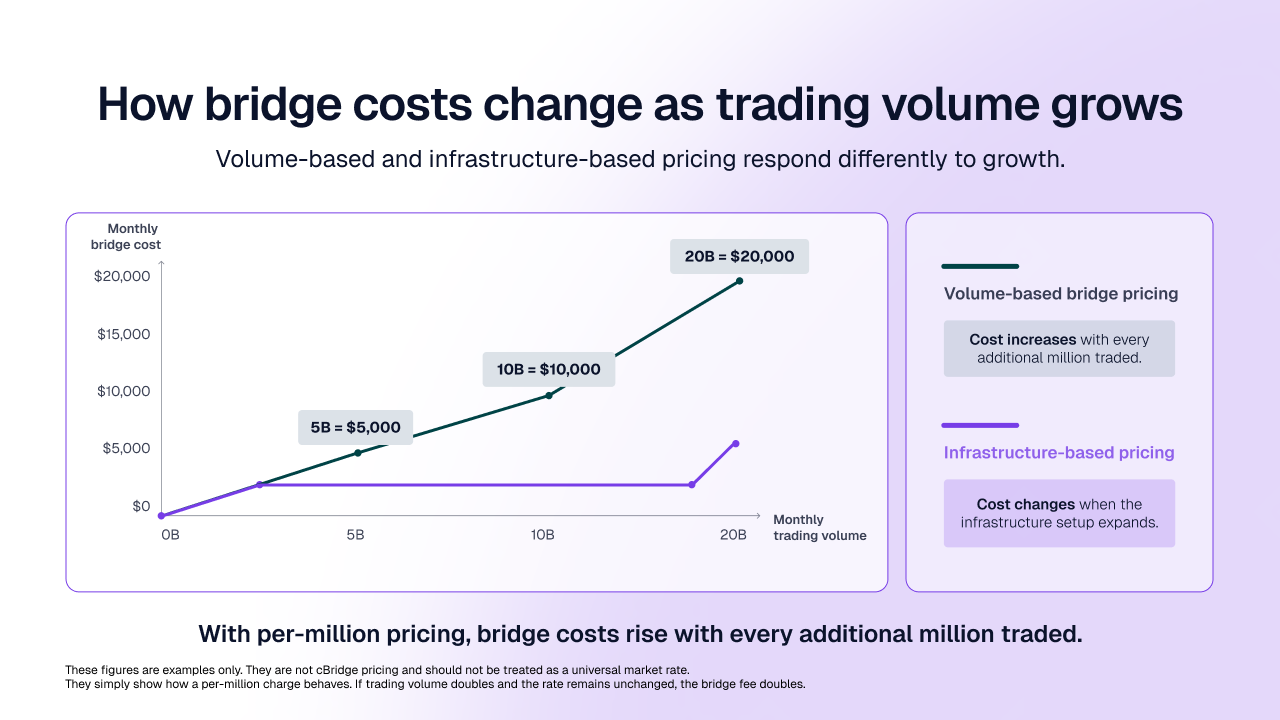
Under a volume-based model, the broker pays according to the amount of activity processed through the bridge. The charge is commonly expressed as a fee per million traded:
Monthly bridge fee = monthly trading volume ÷ 1 million × per-million fee
At an illustrative rate of $1 per million:
$5 billion in monthly volume produces a $5,000 bridge fee.
$10 billion produces a $10,000 bridge fee.
$20 billion produces a $20,000 bridge fee.
Why volume-based bridge pricing can become a growth penalty?
The bill can rise without an infrastructure change
A broker may use the same trading servers, liquidity providers and routing structure from one month to the next. If client activity rises, the bridge invoice can still increase materially.
Yet higher trading volume usually requires little or no change to the underlying bridge infrastructure. The same servers, connections and routing setup continue to process the flow, while the provider’s actual infrastructure costs typically increase only marginally.
The broker is paying more simply because more volume passes through the existing setup. The bridge cost line expands with activity even when the core technical configuration remains unchanged.
Budgeting becomes tied to variable activity
Trading volume can change with market volatility, seasonality, client mix, campaign performance, IB activity and the behaviour of high-value traders.
A broker may budget around normal activity, then receive a higher invoice after a volatile period or successful growth campaign. For start-up brokers, an unexpected increase can put pressure on cash flow and force spending cuts elsewhere. For established brokers, it can erode margins, disrupt annual budgets and turn growth into an unplanned infrastructure expense.
Model the price at the volume you plan to reach
A volume-based model can look economical while a brokerage is small. The better test is what the model costs at the next stage of growth.
Broker CEOs should model the liquidity bridge cost at three levels:
current monthly volume
expected volume after the next growth phase
a high-activity month above forecast
The evaluation should also include minimum fees, pricing tiers, and thresholds to enable a forward-looking business decision rather than a review of today’s invoice.
Infrastructure-based liquidity bridge pricing
Infrastructure-based pricing changes the unit being charged. Instead of billing for every million traded, the cost is linked to the bridge configuration, such as the core bridge server, trading server connections and liquidity provider connections.
Costs can still change if the broker adds another platform, server, LP connection or additional capacity. When additional capacity is required, the cost changes as a planned infrastructure step rather than increasing continuously with every million traded. The difference is that the increase reflects an expansion of the setup rather than every rise in client trading activity.
Infrastructure-based pricing separates two types of growth. One is more use of the same setup, while the other is an expansion of the setup itself:
Trading volume growth: more client trading passes through the existing bridge setup, without adding new trading environments, LP connections or capacity.
Infrastructure growth: the broker adds trading environments, LP connections or capacity.
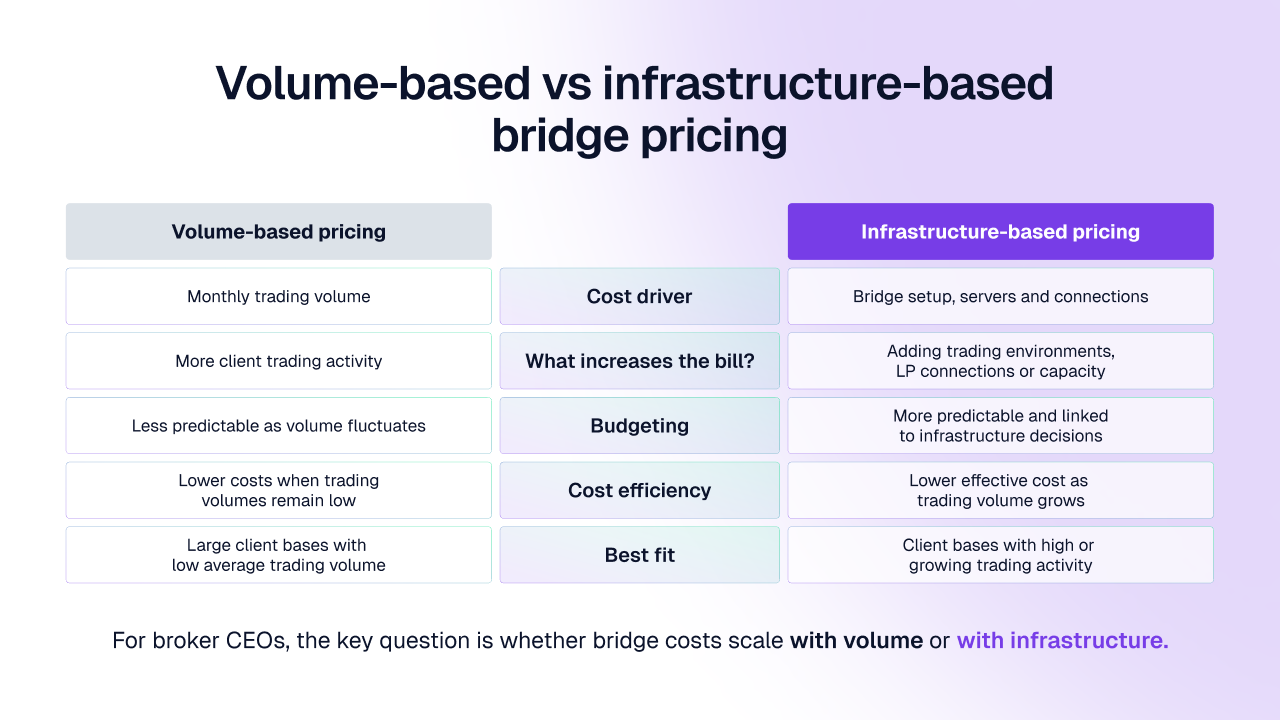
For brokers seeking predictable liquidity bridge pricing, this creates a clearer relationship between cost and the technology actually being used. It also makes it easier to identify why the invoice has changed and which part of the infrastructure created the additional cost.
What should brokers compare when reviewing forex/CFD bridge pricing?
A liquidity bridge cost comparison should extend beyond the headline monthly fee.
Pricing structure
Is pricing based on traded volume, infrastructure or both?
Is there a per-million bridge fee?
Are minimum charges, pricing tiers or thresholds involved?
What specifically causes the monthly invoice to increase?
Does trading more through the existing setup automatically increase the fee?
Infrastructure and capacity
How many trading platforms and LP connections are included?
How is additional capacity added and charged?
Operational value
How are routing rules configured, checked and monitored?
What reporting, alerting and exposure tools are included?
How are migration, maintenance and ongoing support handled?
Are important controls included in the core setup or sold separately?
These questions are particularly relevant when comparing MT5 bridge pricing, fixed-price liquidity bridge models, or liquidity bridges for high-volume brokers. The lowest initial fee may not create the most predictable total cost once volume and infrastructure requirements expand.

How cBridge keeps liquidity bridge costs predictable?
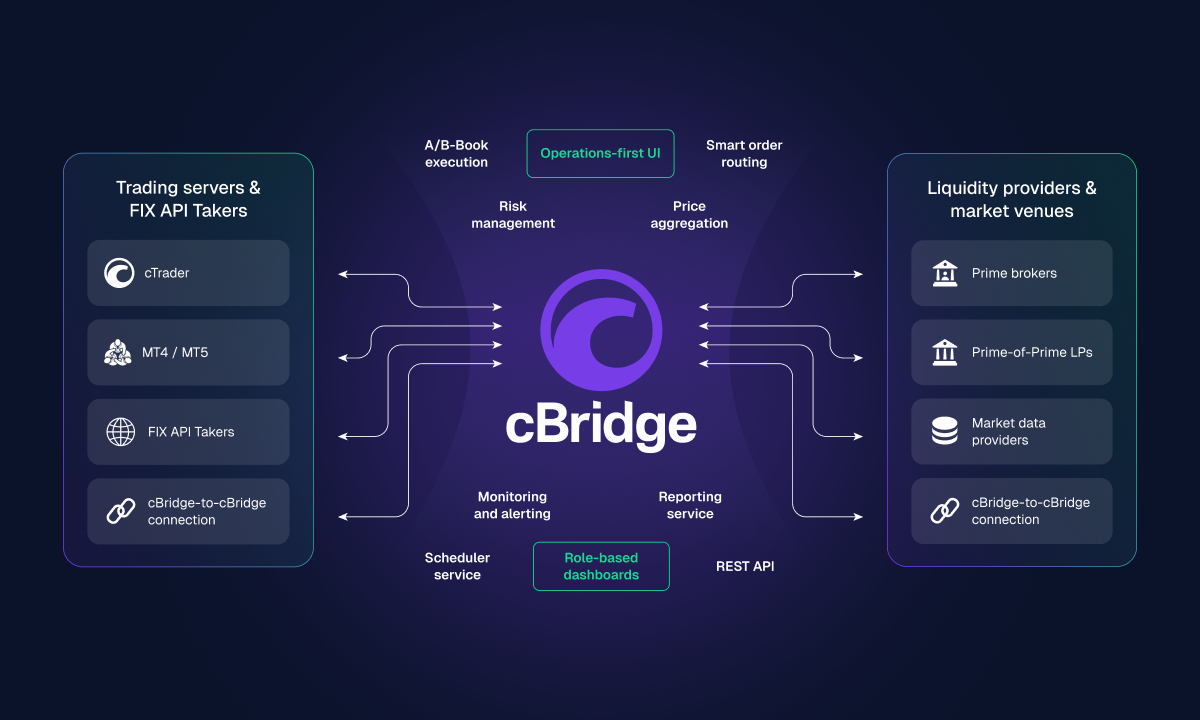
cBridge is a standalone, platform-agnostic liquidity bridge for FX and CFD brokers. It can connect and integrate into any platform, including cTrader, MT4, MT5 and FIX API trading environments to multiple liquidity providers, allowing brokers to manage liquidity access, pricing, routing and execution across connected servers.
Pricing linked to the technical setup
cBridge uses fixed, infrastructure-based pricing with no volume fees or hidden charges. Its cost structure is based on the cBridge Server, the Taker connections required for the broker’s trading environments and the LP connections required for liquidity access.
Infrastructure costs may change if the broker expands its setup by adding trading environments, LP connections or capacity. However, increased trading volume through the existing configuration does not incur a separate per-million fee.
It gives brokers a clearer connection between the bridge cost and the infrastructure they actually use. It also makes it easier to understand why costs change and to plan for future expansion.
Potential liquidity bridge cost savings will vary by broker and depend on factors such as the current provider agreement, monthly trading volume, platforms, servers, connections and capacity requirements.
One bridge across multiple trading environments
cBridge can connect cTrader, MT4, MT5, and FIX API environments through a single bridge. This is particularly relevant for brokers running more than one platform or planning to add another trading environment as the business expands.
A platform-agnostic setup reduces the need to manage separate bridge arrangements for each environment. It also gives dealing and operations teams one place to manage liquidity access, unified quote pricing and routing rules across connected servers.
Operations-first design and validation
Bridge value goes beyond pricing. Dealing and operations teams need to configure streams, symbols and routing rules accurately, understand how settings interact and identify issues quickly.
cBridge uses guided layouts, context panels and cross-setting references to keep related configuration visible. Colour-coded validation highlights inactive rules, conflicting parameters, deleted symbols and rules overridden by higher-priority instructions.
Cross-setting checks help identify inconsistencies across symbols, streams, trading servers, and routing rules before deployment, supporting faster configuration, easier troubleshooting, and stronger routing control as the setup becomes more complex.
Monitoring, reporting and modular infrastructure
cBridge consolidates exposure and activity data from connected trading platforms and liquidity providers into role-based dashboards. Dealers, risk managers, operations teams and executives can clearly view the information and KPIs relevant to their responsibilities.
Reporting covers execution and order activity, trading volume, slippage and mark-outs. Alerts can surface connectivity issues, trading server events, pricing inconsistencies, execution-related signals and cBridge operational events.
Its modular architecture allows resource-intensive components to scale, update or undergo maintenance independently without interrupting the rest of the bridge. By isolating these components, cBridge can maintain continuity as demand increases and contain local issues before they affect the wider setup.
cBridge Antifraud is included with the core server configuration, adding bundled value beyond connectivity and routing.
What this means for brokers
With cBridge, brokers can:
Grow trading volume without automatically increasing bridge fees
Connect cTrader, MT4, MT5 and FIX API environments through one bridge
Pay for the infrastructure and connections they actually use
Scale the setup up or down as operational requirements change
Use a free evaluation period of up to 30 days before moving to a live environment
Start live billing only after live bridge credentials are provided
Manage liquidity access, pricing and routing from a central environment
Identify configuration conflicts before they affect live routing
Monitor exposure, execution activity and operational events through role-based dashboards
Access bundled antifraud functionality as part of the core server configuration
Together, these capabilities strengthen the cBridge value proposition beyond pricing alone. Brokers receive a bridge designed around predictable costs, multi-platform connectivity, routing control, and operational visibility, all of which can expand with the business.
Conclusion
Liquidity bridge pricing should be evaluated against the business a broker plans to become, not only the volume it processes today.
Under volume-based pricing, a successful month can produce a higher bridge bill even when the underlying setup has not changed. Infrastructure-based pricing ties cost more closely to the servers, connections and capacity the broker actually uses.
cBridge gives FX and CFD brokers a more predictable way to plan bridge costs. Its infrastructure-based pricing removes volume fees, while multi-platform connectivity, operations-first configuration, routing validation, monitoring and reporting support the wider dealing environment.
For brokers planning to increase volume, add trading platforms, or expand liquidity relationships, cBridge provides a clearer, more manageable path to scale.
Bridge infrastructure should support business growth, not become more expensive as clients trade more.
Calculate your potential bridge cost savings.
FAQ
What is liquidity bridge pricing?
Liquidity bridge pricing is the way a broker pays for technology that connects trading environments to liquidity providers. Fees may be based on traded volume, bridge infrastructure, trading server connections, LP connections or a combination of these factors.
Which trading platforms can be integrated with cBridge?
cBridge is platform-agnostic and is not limited to a single trading platform. It supports cTrader, MT4 and MT5 directly, while other trading platforms can be integrated through a supported interface such as FIX API, subject to their technical compatibility and integration requirements. This allows brokers to connect current and future trading environments through one liquidity bridge.
What is a per-million bridge fee?
A per-million bridge fee is a volume-based charge applied to each million in traded volume. At an illustrative rate of $1 per million, a monthly volume of $20 billion would yield a $20,000 bridge fee. How an FX and CFD broker cut liquidity bridge costs by 58%
Why do liquidity bridge fees rise as trading volume grows?
Under volume-based bridge pricing, the fee is calculated from the amount traded. The invoice can therefore rise even when the broker uses the same trading servers, liquidity providers and routing setup.
What is a fixed-price liquidity bridge?
A fixed-price liquidity bridge uses infrastructure-based pricing rather than charging for each unit of traded volume. Costs may change when the broker adds servers, connections or capacity, but not simply because monthly trading volume rises. How to choose a liquidity bridge in 2026: A decision framework for brokers
Can brokers use a liquidity bridge without volume fees?
Yes. A liquidity bridge without volume fees uses an infrastructure-based model rather than charging based on monthly trading activity. cBridge links costs to the required cBridge Server, Taker connections, and LP connections rather than to liquidity bridge volume fees.
What should brokers compare when reviewing MT5 bridge pricing?
Brokers should compare the pricing basis, per-million fees, included Taker and LP connections, capacity rules, platform compatibility, routing controls, monitoring, reporting, maintenance and migration support.
Does cBridge charge volume fees?
No. cBridge uses pricing based on servers and connections, with no volume fees or hidden charges. Costs are linked to the servers and connections required by the broker rather than monthly trading volume.
Keep reading

Best liquidity bridge providers for brokers in 2027: a practical comparison
Comparing liquidity bridge providers? See how cBridge, oneZero, PrimeXM, FXCubic, Centroid Solutions and Tools for Brokers stack up against the same public criteria.
 cBridge team
What is a liquidity bridge? A practical guide for FX and CFD brokers
Learn what a liquidity bridge does, how it connects trading platforms to liquidity providers, and how brokers use it for pricing, routing and execution.
cBridge team
How to switch liquidity bridge provider without disrupting trading
Thinking about switching liquidity bridge providers? A practical framework for migrating safely, using parallel deployment, configuration mapping and phased cutover.
cBridge team