
Spotware's new AI-powered fraud detection solution helps brokers and prop firms uncover coordinated trading activity that may be difficult to identify within one company's data. cAntifraud combines behavioural analysis with intelligence from participating firms, giving risk teams more context to investigate potential abuse and assess its financial impact.
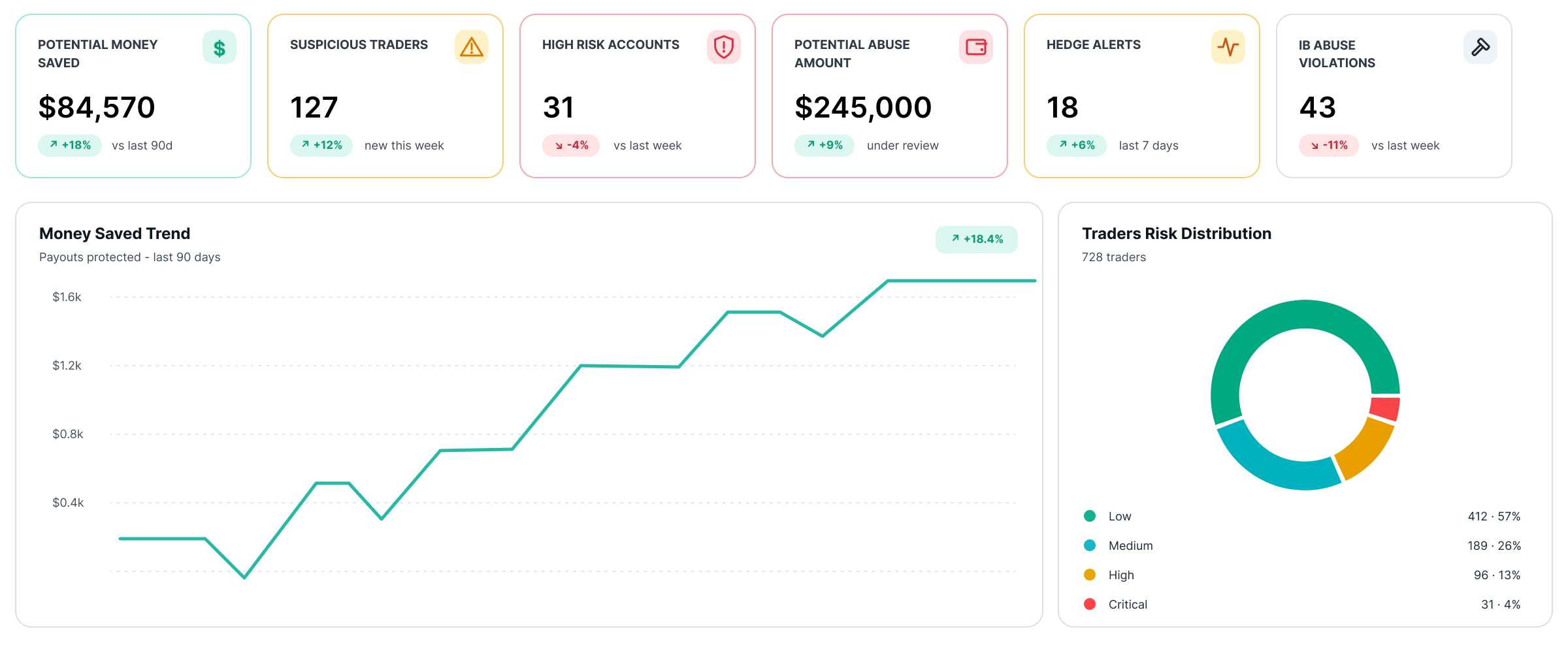
The product addresses a gap in how firms detect trading abuse: activity may span several companies, while each risk team sees only the accounts within its own business.
"Trading abuse doesn't stop at the boundaries of a single firm, but that's often where a risk team's visibility ends. It's difficult to recognise suspicious patterns when you're only seeing part of the picture," said Pavel Demin, General Manager of cAntifraud at Spotware.
Connecting signals across participating firms
cAntifraud brings participating brokers and prop firms into a shared intelligence network. Signals identified at one firm can help other participants recognise related accounts and potential cross-firm hedging or coordinated trading schemes.
When suspicious activity is detected, the system notifies participants so their teams can investigate potentially connected activity. This adds context that may be missing when a firm reviews only its own trading data.
The network exchanges encrypted and anonymised data. Participants retain control of their own data and cannot access another firm's client information.
Monitoring before the payout review
Potential abuse can surface during a payout review, leaving a team to investigate while the client waits for funds. Any delay can lead to disputes and additional work for risk and support staff.
cAntifraud evaluates risk signals during onboarding, including initial know-your-customer (KYC) checks, and continues monitoring once trading begins. It analyses trading patterns and execution timing alongside links between accounts, giving teams evidence to review before a payout request makes the investigation urgent.
Assessing the financial exposure
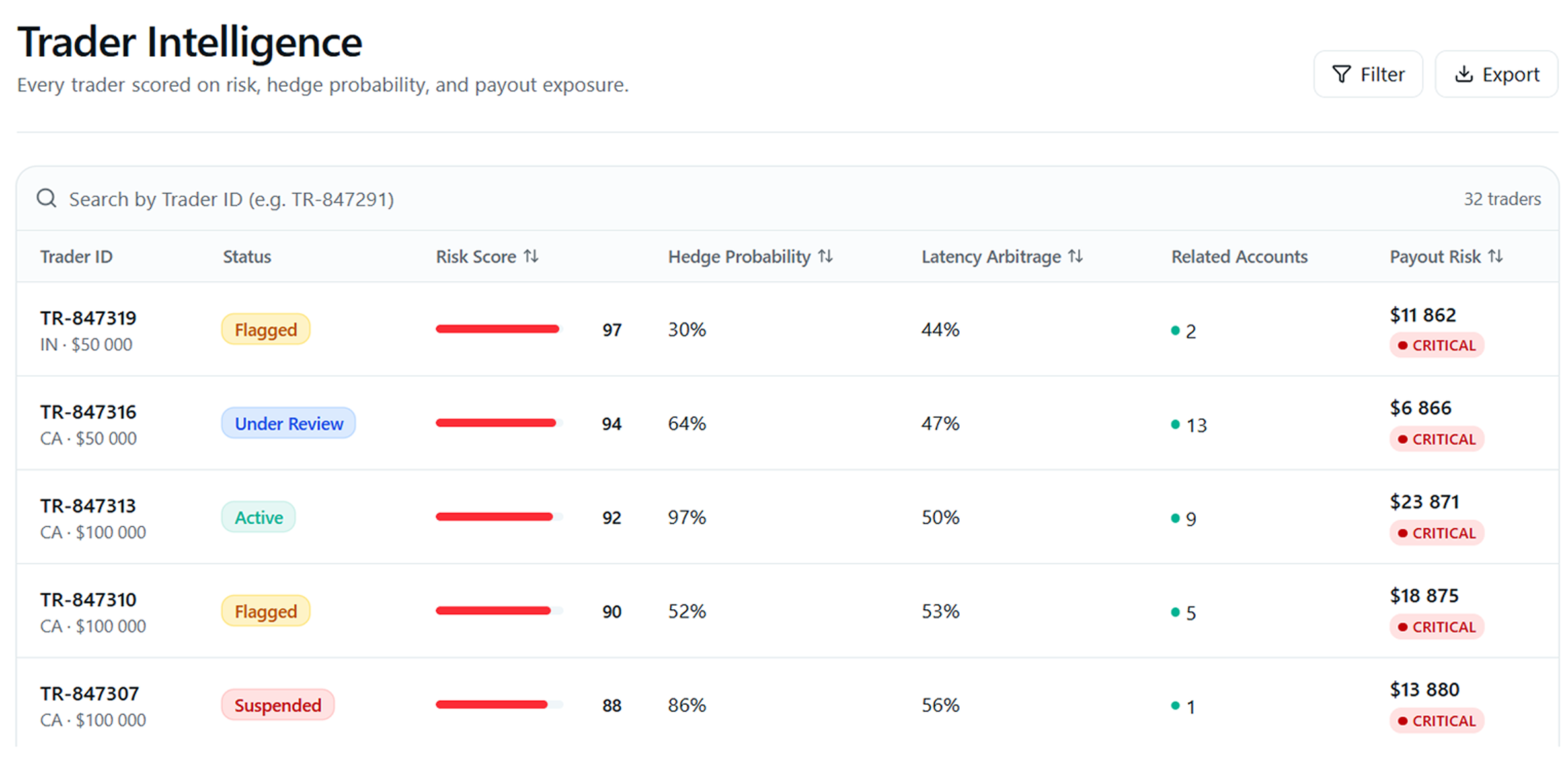
cAntifraud combines trader risk evaluation with estimated payout exposure, helping firms prioritise investigations by their potential financial impact.
For FX/CFD brokers, it targets IB commission abuse, latency arbitrage, coordinated trading and multi-accounting. Detection also covers cross-broker hedging and abuse involving copy trading, bonuses or zero-balance protection.
For prop firms, it addresses challenge farming, external hedging and breaches of trading rules. Automated rule monitoring flags potential violations during trading, reducing reliance on manual checks ahead of a payout.
Decisions stay with the firm
cAntifraud supplies evidence for risk teams to assess. It does not automatically block traders or approve or reject payouts. Decisions on accounts and payouts remain with the firm.
The focus is on signs of potential abuse. Profitable trading by a legitimate trader is not, in itself, a reason for action.
Available independently and included with cBridge
cAntifraud is available as a standalone product. Its universal API supports connections to cTrader and other major trading platforms, liquidity bridges and CRMs. It can complement existing risk management systems without replacing the firm's trading infrastructure.
For cBridge clients, cAntifraud is included at no additional cost. Brokers can use it as part of Spotware's liquidity bridge alongside liquidity aggregation, order routing and execution management.
To explore the bridge offering, including cAntifraud, book a cBridge demo.
You may also like

Spotware partners with Techysquad to connect CRM and trading data
Spotware partners with Techysquad to connect Forex CRM with cTrader, while cBridge complements the setup with liquidity connectivity and execution.
 cBridge team

Meet cBridge at FX.world 2026 in Rome
The Spotware team will attend FX.world 2026 in Rome from 2 to 5 November, bringing together discussions on trading technology, liquidity connectivity and business growth.
cBridge team
Meet cBridge at London Prop Trading Expo 2026
The cBridge team will be attending London Prop Trading Expo 2026 on 23–24 October.
cBridge team